In fast-paced commercial kitchens, awareness is critical. Verbal cues like “corner” or “door” are meant to prevent collisions, but in loud, high-stress environments they’re easy to miss. These breakdowns in communication can lead to accidents, delays, and inefficient workflow. Kitchen Flow Control (KFC) explores how low-cost automation can improve safety and efficiency by reducing reliance on human communication in critical moments.
Using ESP32 microcontrollers communicating over ESP-NOW, KFC monitors high-traffic areas and dish return stations and responds with localized audio alerts and centralized event logging.

System Design
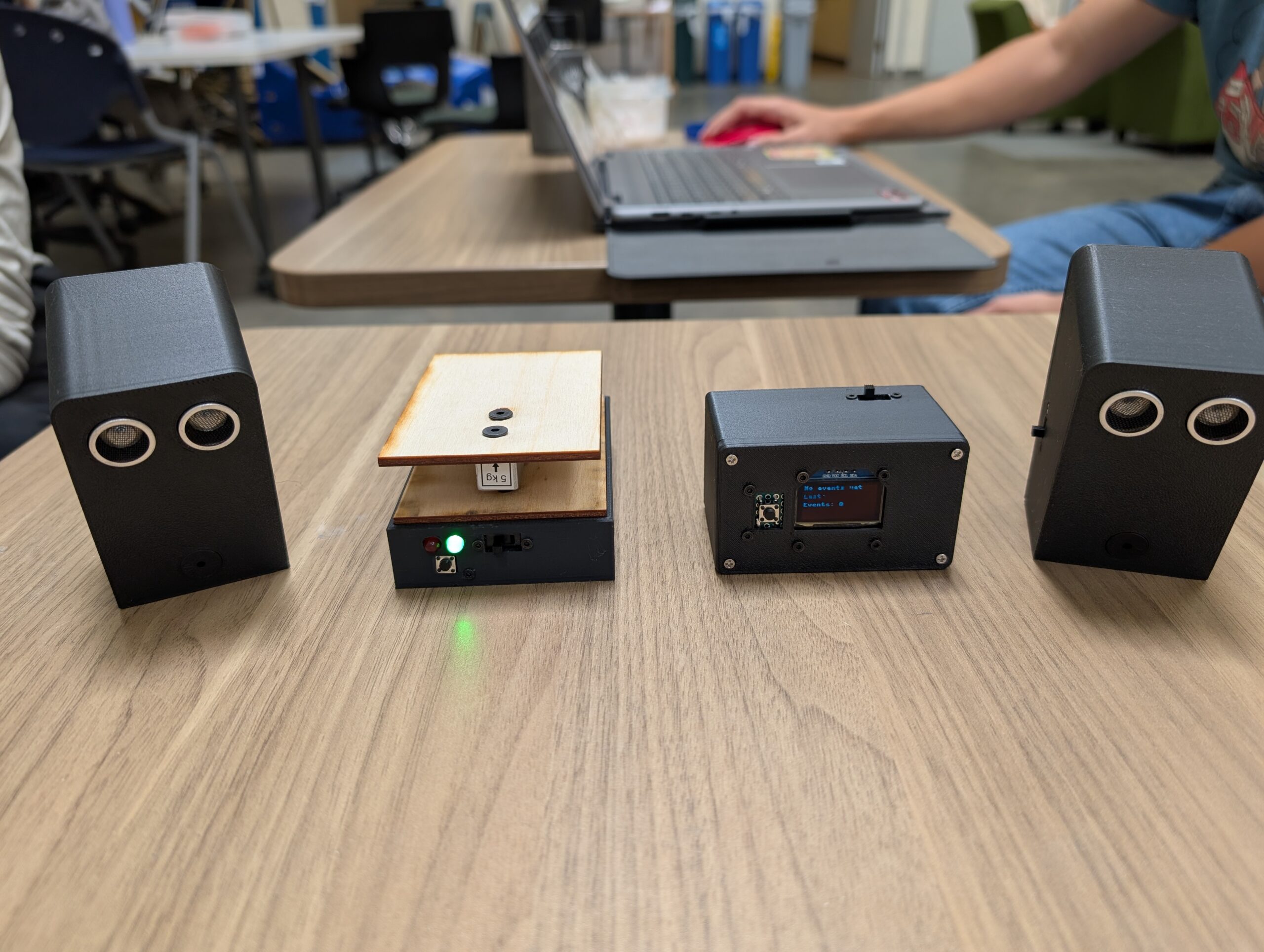
KFC consists of four primary modules. Two function as door alarm units, placed on opposite sides of a kitchen doorway. Each unit uses an ultrasonic sensor to detect approaching motion and a buzzer to issue an audible warning. When motion is detected, both units trigger simultaneously, alerting staff on either side of the door. Different alert tones are used for each side to make the signals immediately distinguishable, even in noisy environments.
A third module is a dish-bin monitoring unit designed to sit beneath a dish return station. Using a load cell and HX711 amplifier, this module tracks the accumulated weight of dishes. Once a predefined threshold is reached, the system issues an alert indicating that the bin needs to be cleared, helping prevent bottlenecks and reduce staff downtime.
The final module serves as a central server, receiving signals from all devices and logging events with timestamps and sensor identifiers. This creates a record of kitchen activity that can be used to evaluate traffic patterns and system performance.
Testing and Iteration
Testing showed that the ultrasonic sensors reliably detected human motion within approximately two meters, with near-instantaneous alarm activation. The load cell system consistently triggered alerts at the calibrated threshold. Early prototypes suffered from false triggers, largely due to sensor sensitivity and unstable mounting. These issues were resolved through improved mechanical mounting and more careful calibration.
One of the key takeaways from this project was the importance of hardware integration. Even inexpensive components performed reliably when properly mounted and thoughtfully programmed, and small mechanical improvements often had a greater impact than changes in code alone.
Reflection
Kitchen Flow Control demonstrates how simple, distributed sensing systems can meaningfully improve safety and workflow in demanding environments. While developed for restaurant kitchens, the same approach could be adapted for other spaces where awareness and timing are critical. The project emphasized system-level thinking, iterative prototyping, and the value of combining mechanical, electrical, and software design into a cohesive solution.